
AMD vs Intel CPUs in 2026: Real Prices & Benchmarks
By the RigVault Hardware Team · Last updated September 5, 2026 · Pricing and benchmarks checked against independent testing as of publication
Rather than picking a side, this breaks the AMD-vs-Intel question down by real matchups and real benchmark data, since the better brand genuinely changes depending on your price tier and workload.

The Flagship Gaming Matchup: Ryzen 7 9800X3D vs Core Ultra 9 285K
This is the comparison that actually decides most gaming-focused builds right now.
Real Pricing (Mid-2026)
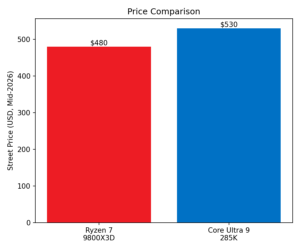
Price comparison between Ryzen 7 9800X3D and Core Ultra 9 285K
Gaming Benchmarks
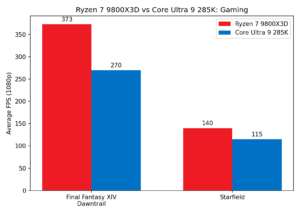
TechSpot’s 45-game test suite measured the 9800X3D ahead of the Core Ultra 9 285K by 24% on average frame rates and 29% on 1% lows — with no single game in the suite where the Intel chip came out faster. Other 2026 roundups have put the gap as wide as 35-40% in cache-sensitive titles like Assetto Corsa Competizione, where the 9800X3D’s 96MB of 3D V-Cache gives it a decisive edge.
Productivity Benchmarks — The Result Flips
Move away from gaming and Intel takes a clear lead. Tom’s Hardware measured the Core Ultra 9 285K roughly 81% ahead of the 9800X3D in Cinebench 2024 multi-core, and nearly 99% ahead in POV-Ray multi-core rendering.
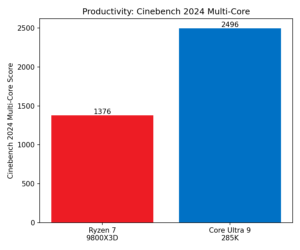
Cinebench 2024 multi-core productivity benchmark
Power Efficiency
Independent testing found the Ryzen 7 9800X3D drawing roughly 53% less power than the Core Ultra 9 285K under equivalent gaming load, which also translates to lower cooling requirements for the AMD platform.
Tier Verdict: Which Chip Actually Wins
Mid-Range Tier: Where Most Builders Actually Land
Real Examples and Pricing
• AMD Ryzen 5 9600X (~$182) — 6 cores, 32MB L3, 65W — best pure budget gaming pick
• Intel Core Ultra 5 250K Plus (~$199) — 18 cores (6P+12E), 24MB L3, 125W — better for gaming plus streaming
• Intel Core Ultra 7 270K Plus (~$299) — 24 cores (8P+16E), 36MB L3, 125W — widely cited as the best mid-range all-rounder of 2026
• AMD Ryzen 9 9900X3D (~$599) — 12 cores, 128MB 3D V-Cache, 120W — gaming plus content creation
The High-End Multi-Core Option: Ryzen 9 9950X3D
For builders who want gaming performance without giving up heavy multi-threaded work, AMD’s higher-core X3D chips close much of the productivity gap while keeping the gaming lead.
Real Benchmark Data
Tom’s Hardware’s own testing found the Ryzen 9 9950X3D running about 37% faster than the Core Ultra 9 285K in 1080p gaming — inheriting nearly all of the 9800X3D’s gaming advantage — while adding significantly more multi-threaded headroom for rendering, compiling, or streaming alongside gaming.
Platform Longevity: A Real, Practical Difference
AMD’s AM5 socket has been supported since 2022 across multiple CPU generations, meaning a Ryzen 7 9800X3D drops into the same motherboards used for earlier AM5 chips. Intel’s socket changes have historically come more frequently, though the Core Ultra 200S “Plus” refresh notably dropped into existing 800-series boards with only a firmware update — a rare exception to Intel’s usual cadence.
Conclusion
There’s no single winner between AMD and Intel in 2026 — the Ryzen 7 9800X3D decisively wins gaming at every resolution where CPU performance matters, while Intel’s Core Ultra lineup still leads multi-threaded productivity work by a wide margin. Match the choice to your actual workload rather than brand reputation, and check the specific matchup at your price tier before buying.
2 Replies to “AMD vs Intel CPUs in 2026: Real Prices & Benchmarks”