Best Prebuilt PC in 2026: 8 Tested Picks & Real Prices
By the RigVault Hardware Team · Last updated September 18, 2026 · Pricing and benchmark data checked against independent testing as of publication
Component prices have made DIY building less of a slam-dunk value proposition than it used to be, which means a well-chosen prebuilt is a genuinely smart buy for a lot of people in 2026. Rising RAM and SSD costs through the year have narrowed — and in some cases reversed — the traditional cost advantage of building your own system, so this guide focuses on real, currently tested machines rather than generic advice. Below are five primary picks across budget, premium, compact, and upgrade-friendly categories, plus three additional strong options for quiet operation, small form factor, and deep customization, all with real specs, prices, and benchmark results.
FULL COMPARISON
Quick Comparison
The Top 5 Prebuilt PCs, Tested and Compared
Best Overall: iBuyPower RDY Element 9 Pro R07
This build pairs an AMD Ryzen 7 7800X3D with a Radeon RX 9070 XT, 32GB of DDR5 RAM, and a 2TB PCIe Gen 4 SSD. At just over $2,000, it isn’t cheap, but it currently undercuts the cost of building an equivalent system yourself — RAM and SSD pricing have climbed enough in 2026 that self-building often isn’t the value play it used to be.In testing, it handled Black Myth: Wukong at 4K Cinematic settings at close to 60 FPS, and its liquid cooling keeps performance sustained under long sessions. It also edges out Nvidia RTX 5070-based competitors from Alienware and HP Omen in several titles, thanks to the RX 9070 XT’s strong rasterized performance. The included keyboard and mouse are the weak point — budget for replacements if peripherals matter to you.prebuilt-vs-custom-pc
Best Budget: Dell Tower Plus
Despite its plain, non-gaming-looking case, the Dell Tower Plus can be configured with real gaming hardware — the tested unit ran an Intel Core Ultra 5 255H, Nvidia RTX 5070, and 32GB RAM. Pricing is highly configurable, starting around $999 and running up past $3,000 depending on spec, with the gaming-relevant configuration landing around $1,693.Its subtle, nondescript case is a genuine strength for anyone who doesn’t want an obviously “gamer” aesthetic in a shared living space or office, though it comes at the cost of accessibility — the case is harder to open for upgrades than most gaming-branded towers. It also tops out at an RTX 5080; if you specifically want RTX 5090 headroom, look elsewhere on this list.
Best Premium: Alienware Area-51
For builders with a bigger budget, the Area-51 pairs an Intel Core Ultra 9 285K with an RTX 5090 and 64GB of RAM. Starting near $4,000, this is a genuine investment, but the positive-pressure cooling system keeps noise remarkably low even under sustained heavy load — a real differentiator at this performance tier, and one of the reasons it topped nearly every benchmark in this comparison. At 1080p native, it posted 120 FPS in Cyberpunk 2077 during testing, dropping to a still-strong 56 FPS at 4K — the highest result among the primary five picks at both resolutions.The trade-off is size and weight. This is one of the largest prebuilt towers on the market, heavy enough that floor placement is the practical choice over a desk. If desk space is tight, the Corsair One i500 below delivers a meaningful fraction of this performance in a dramatically smaller footprint. best-gpu-for-1440p-gaming-2026
Best Compact: Corsair One i500
The Corsair One i500 packs an Intel Core i9-14900K, RTX 4080 Super, and 32GB RAM into a distinctly smaller footprint than a traditional tower, without giving up much performance — it ran quiet even under Cyberpunk 2077 at max settings in testing (97 FPS at 1080p, 29 FPS at 4K), and its wood-and-fabric exterior design stands out from the typical glass-panel gaming aesthetic.The trade-offs are real: limited configuration options (only two available at time of testing), a genuinely difficult upgrade path due to its compact design, and GPU swaps require shipping the unit back to Corsair rather than doing it yourself. It’s a strong pick specifically for buyers who value looks and quiet operation over long-term upgrade flexibility.
Best Upgradable: HP Omen 35L
Configurable up to an AMD Ryzen 7 9800X3D, 64GB RAM, and an RTX 5080, the Omen 35L’s real selling point is its tool-less side panel — you can pop it open and swap a GPU, add RAM, or refresh storage without hunting for a screwdriver. The tested configuration (Ryzen 7 9800X3D, RTX 5070 Ti, 32GB) topped 120 FPS at 4K with DLSS frame generation enabled, ran 91 FPS natively at 1080p in Cyberpunk 2077, and stayed cool and quiet even under extended heavy load.The main downsides are bloatware that needs clearing out after setup, and a price that climbs quickly once you move past the base configuration — start modest and upgrade individual parts later rather than maxing out the configurator on day one. “read our guide to future-proofing your build through upgrades”
Best Quiet: Corsair Vengeance i8300
If noise matters more than price, the Vengeance i8300 pairs an Intel Core Ultra 9 285K with an RTX 5090, 64GB DDR5, and a combined 6TB of SSD storage across two drives. Even after hours of Cyberpunk 2077 or Doom at maxed-out settings, testing found the fans never rose above a low hum — genuinely rare at this performance tier.At roughly $4,500 on sale (down from just under $5,000), it’s priced above the Alienware Area-51 for similar raw performance, and the Area-51 actually wins on price-to-performance. Choose the Vengeance i8300 specifically if sustained near-silent operation is a hard requirement rather than a nice-to-have — it’s also worth noting the case alone is over 30 pounds and roughly two feet tall, so floor placement is essentially mandatory.
Best Mini PC: Framework Desktop
For a completely different form factor, the Framework Desktop uses an AMD Ryzen AI Max 385 with integrated Radeon 8050S graphics and 32GB of soldered LPDDR5x memory, starting around $1,099. It won’t compete with any discrete-GPU system on this list for raw gaming performance, but its compact, highly repairable design with swappable Expansion Cards for front ports is unmatched for customization in a small form factor.This is the right pick if you want a capable, quiet, highly portable system for lighter gaming, general use, or local AI workloads — not if 4K or even demanding 1440p gaming is the priority. Cyberpunk 2077 ran at a modest 22 FPS at 1080p in testing, reflecting its integrated-graphics limitations clearly.
Best Customizable: Maingear MG-1 Ultimate
The Maingear MG-1 Ultimate can be configured with an AMD Ryzen 9 9950X3D and an RTX 5090, alongside swappable magnetic front panels reminiscent of the old Xbox 360 faceplate customization — a genuinely fun, distinctive touch. Testing showed 146 FPS at 1080p and 53 FPS at 4K in Cyberpunk 2077, putting it at the very top of this entire comparison for raw performance, narrowly ahead of even the Area-51.Pricing scales steeply with configuration, so this is best suited to buyers who specifically want deep personalization options alongside flagship-tier performance, and don’t mind paying a premium for both.
Gaming Performance, Compared
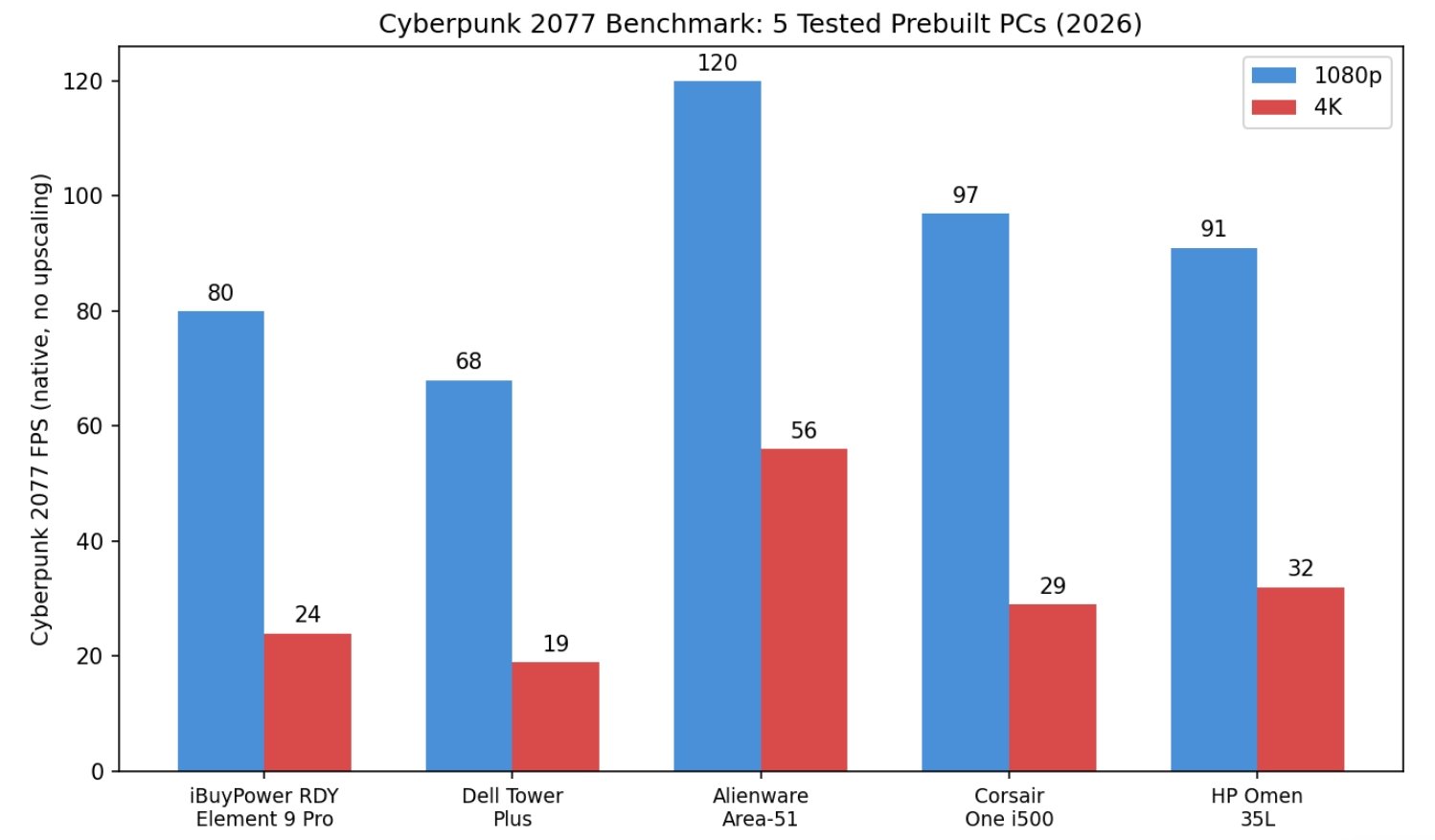
Cyberpunk 2077 benchmark comparison across 5 tested prebuilt PCs
What a Good Prebuilt Should Actually Deliver
At 1080p native (no upscaling), the Alienware Area-51’s RTX 5090 leads the primary five at 120 FPS in Cyberpunk 2077, followed by the Corsair One i500 at 97 FPS and the HP Omen 35L at 91 FPS. At 4K, the gap widens further in the Area-51’s favor, reflecting the RTX 5090’s much larger performance ceiling over the rest of the field. Among the three additional picks, the Maingear MG-1 Ultimate’s 146 FPS at 1080p actually edges out the Area-51 itself, underscoring how much configuration flexibility affects results even within similar GPU tiers.
Pricing follows a broadly similar shape to performance, though not perfectly. The Dell Tower Plus and HP Omen 35L (on sale) offer the most accessible entry points among the primary five, while the Alienware Area-51’s roughly $4,100 price tag reflects its RTX 5090 and significantly larger cooling and case engineering. Notably, the Corsair Vengeance i8300 pushes past $4,500 for similar raw performance to the Area-51, making it a harder value case unless near-silent operation specifically justifies the premium — a good reminder that the highest price on a spec sheet doesn’t always track with the highest tested
performance.
Is It Cheaper to Build Your Own PC in 2026?
For most of the past decade, DIY building was the clear value choice. That’s flipped somewhat in 2026: RAM and SSD prices have risen sharply enough that pricing out equivalent components individually often comes out close to, or more than, buying a well-specced prebuilt — a real shift from prior years. A single Corsair DDR5 32GB kit that cost under $100 in 2025 now runs closer to $450, and SSD and GPU pricing has moved in a similar direction.
That doesn’t mean building is a bad choice. It’s still the better option if you want full control over every individual component, plan to reuse parts from an older system, or specifically want a case and aesthetic a prebuilt doesn’t offer. But the “building is always cheaper” assumption genuinely no longer holds across the board — check current pricing for both routes before assuming either is automatically the better financial choice.
read our full cost and control comparison between building and buying
How to Choose the Right Prebuilt for Your Needs
For 1080p gaming, look for at least an RTX 5060-class GPU. For 1440p, target an RTX 5070 or RX 9070-class card. For 4K, you’ll want an RTX 5080 or RTX 5090 to keep frame rates comfortably high without leaning entirely on upscaling.
check how much VRAM your target resolution actually needs
Beyond resolution, let your specific priority drive the final decision:
• Want the safest all-around pick: the iBuyPower RDY Element 9 Pro R07’s balance of price and performance makes it the default recommendation for most buyers
• Tight budget: the Dell Tower Plus scales down to under $1,000 while still supporting real gaming-relevant configurations
• Desk space is limited: the Corsair One i500 delivers high-end performance in a genuinely smaller footprint, at the cost of upgrade flexibility
• You plan to upgrade over time: the HP Omen 35L’s tool-less design makes it the easiest of this group to open up and modify later
• Noise is a dealbreaker: the Corsair Vengeance i8300 stays near-silent even under sustained maximum load, at a real price premium
• You want something small and portable: the Framework Desktop trades gaming horsepower for size, repairability, and quiet operation
• You want to make a statement: the Maingear MG-1 Ultimate’s swappable panels and flagship-tier configuration options suit buyers who want both performance and personalization
Conclusion
There’s no single “best” prebuilt PC in 2026 — the right pick depends on your budget, desk space, noise tolerance, and how much you value future upgradability. For most buyers, the iBuyPower RDY Element 9 Pro R07 offers the strongest all-around value; budget shoppers should look at the Dell Tower Plus, and anyone planning to upgrade over time should prioritize the HP Omen 35L’s tool-less design. If your priorities are more specific — near-silent operation, a compact footprint, or deep customization — the Corsair Vengeance i8300, Corsair One i500, and Maingear MG-1 Ultimate respectively are worth the added consideration.